|
Lunar Materials Utilization
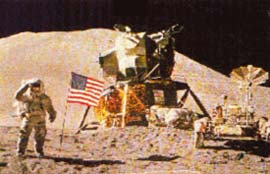
Here is what we accomplished in the 1960s and early 1970s, so why do people say it's so hard in the 2020s?
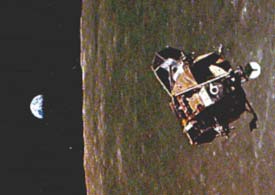
Docking in lunar orbit after human landing on the Moon, 1969
Old NASA artwork:
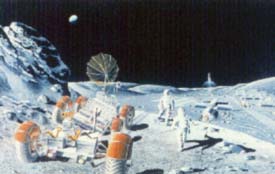
Delivery of lunar oxygen (LunOx) to a space station in lunar orbit. NASA artwork by Mike Carroll.
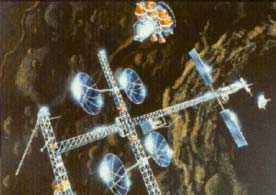
Table of Contents:
Overview of lunar materials and their utilization
The origin and composition of the moon
Highlands vs. Lowlands geology
The Apollo and Luna landings
Major lunar minerals
Mining the surface
Lunar bases
History of lunar probes
Others' webpages on lunar materials and utilization
Lunar materials utilization is addressed in official circles and websites more than asteroidal materials utilization, largely because there is support within NASA for a "Return to the Moon" mission as a steppingstone to Mars. PERMANENT first tries to fill in the gaps that other WWW sites don't address. Usually, this also means presenting a private sector (profitable) scenario rather than a government bureaucracy (taxpayer) scenario.
Roadmap to related topics:
§ Chapter 3:(XR) Transportation of asteroidal materials
§ Chapter 4:(XR) Industrial processing and manufacturing with asteroidal materials
§ Chapter 5:(XR) Space products and services from asteroidal materials
SpaceSettlement.com > Lunar Resources (Mining The Moon)
Additional, children pages of this current parent page: Lunar Resources (Mining The Moon) :
Overview of Lunar Resources
Origin and Composition
Geology, Highlands vs. Lowlands
Apollo and Luna Samples
Major Minerals
Polar Water and Volatiles
Non-Polar Volatiles
Powdery Texture
Mining Lunar Resources
Bases on the Moon
Lunar Probes, History and Future
Clementine 1
Lunar Prospector
SMART 1 (Europe)
Chang-e 1 (China)
SELENE (Japan)
Chadrayaan 1
LRO and LCROSS
Chang-e 2 (China)
Chang-e 3 lander (China)
Chandrayaan 2
Russian Luna 25-29, 2015-2020
Links, Lunar
|
Reasons to do something yourself:
- It will help save life on our special planet -- be part of the solution in your generation.
- It will create and secure a better future for your children and grandchildren.
- It could be an interesting, cool, and a fun adventure for your life!
You can join us and volunteer to help out,
... or ...
If you're short on time, you can just donate:
If you would like to make a donation to help support our humanistic purpose and cause,
then please contact the author at the phone number +66-81-135-7977 by WhatsApp or phone or SMS.
If you really much prefer to send by cryptocurrency, then you can donate into a wallet of any of our cryptocoins, though this is our least preferable way to receive donations ..., so please donate this way only if it's really much more convenient or feasible for you. The wallets are included in my cryptocoin critiques opinion page.
... or ...
Suggest this website to other people and organizations.
|
|
NOTICE:
PERMANENT needs a PHP / MySQL (actually, MariaDB) programmer. Are you a PHP / MySQL programmer interested in getting into space development as a career, or already working in space development? Or do you know somebody else who might be interested?
This is a volunteer, unpaid role at this point in time. A limited paid role would be considered on a tight budget, such as for at least bug fixing with some minor improvements, and/or a security review of our code before it goes online publicly. If you or one of your friends or associates may be interested, please send an email to spaceprogrammer at ... of course this domain.
|
|
To get updates on PERMANENT (occasional, not frequent), get on our mailing list.
For general or specific e-mail regarding PERMANENT, please use our Feedback page.
Leave information about yourself in our people, companies, and organizations database.
If you are interested in hiring our expertise, anywhere in the world, please contact us.
We have people in the USA and Thailand, and can travel or consult by internet.
You can call anytime, 24/7, at +66-8-1135-7977
Text by Mark Prado, Copyright © 1983-2026, All Rights Reserved.
Many website artistic design elements by Sam Fraser, Copyright © 1999-2026, All Rights Reserved.
Except where specifically stated otherwise,
Copyright © 1983-2026 by Mark Evan Prado, All Rights Reserved
(Author reachable by hellomark via this d.n.)
Source: https://www.spacesettlement.com

P rojects to E mploy R esources of the M oon and
A steroids N ear E arth in the N ear T erm

|
|
P rojects to E mploy R esources of the M oon
and
A steroids N ear E arth
in the N ear T erm
This website has a lot of text content, so here are some suggestions on how to navigate and also recognize pages you're seen already vs. still unseen pages in the SiteMap.
There are 2 ways to browse this website:
- A menu floats on the top left (unless you have JavaScript disabled, in which case you must use our SiteMap).
or
- The SiteMap page.
The pulldown menu and the SiteMap are the same tree of pages and links. The pulldown menu offers + and - for expand and collapse sections/subsections/sub-subsections... of the tree, sometimes multiple levels, whereas the SiteMap has everything expanded with no + or - expand and collapse options so the SiteMap is much longer, compared to the pulldown menu (if the pulldown menu is not fully expanded). You may just choose which of the two formats you prefer at a particular time.
One of the benefits of the SiteMap is that links you've already visited become colored red, vs. normal blue for still unseen. It is convenient to browse the SiteMap in one tab or window, and opening pages in other tabs/windows (Ctrl-click or right-click), such as browsing the whole SiteMap to skip pages you've already seen and to choose to open pages you haven't read yet. (Sorry, that kind of color shading hasn't worked in the pulldown menu.)
The pulldown menu doesn't change the color of seen pages, unfortunately, unlike the SiteMap. However, using the pulldown menu, you can quickly browse the list of sections and other pages without leaving the page you're on. The SiteMap is a separate page of its own.
|